
Every traveler entering Djibouti needs a valid visa, a passport with at least 6 months validity, and – if arriving from a yellow fever risk country – a vaccination certificate. The Djibouti eVisa system at evisa.gouv.dj allows you to apply online before departure, while visa on arrival remains available at Djibouti-Ambouli International Airport. This guide covers every document, health requirement, and border procedure you need to know.
Visa Requirements for Djibouti
Virtually all foreign nationals need a visa to enter Djibouti. The country offers two main pathways: the electronic visa (eVisa) applied for online before travel, and the visa on arrival (VOA) obtained at the port of entry.
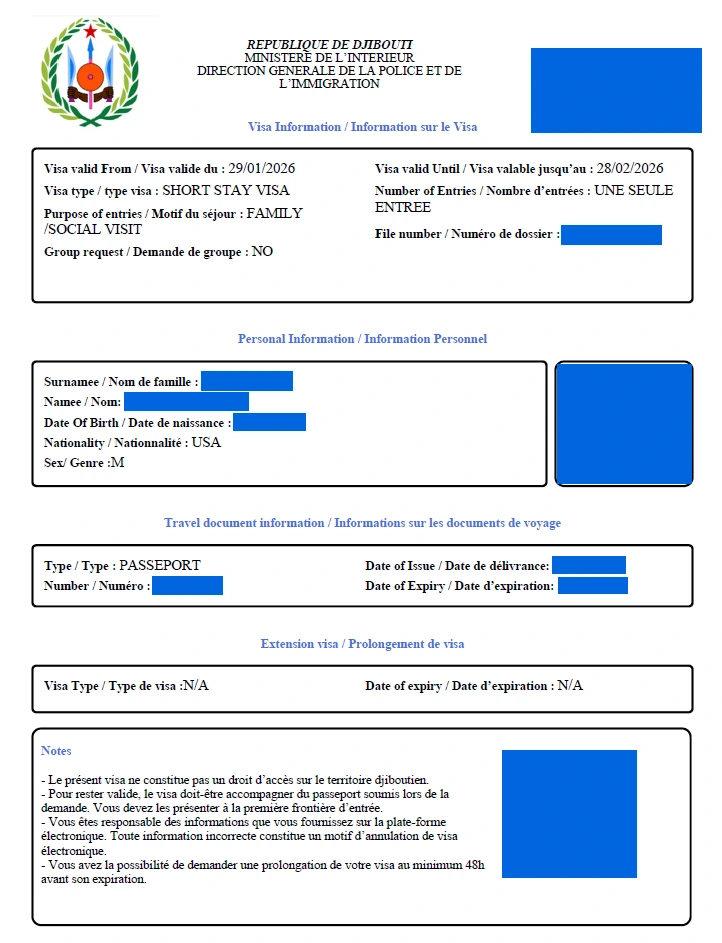
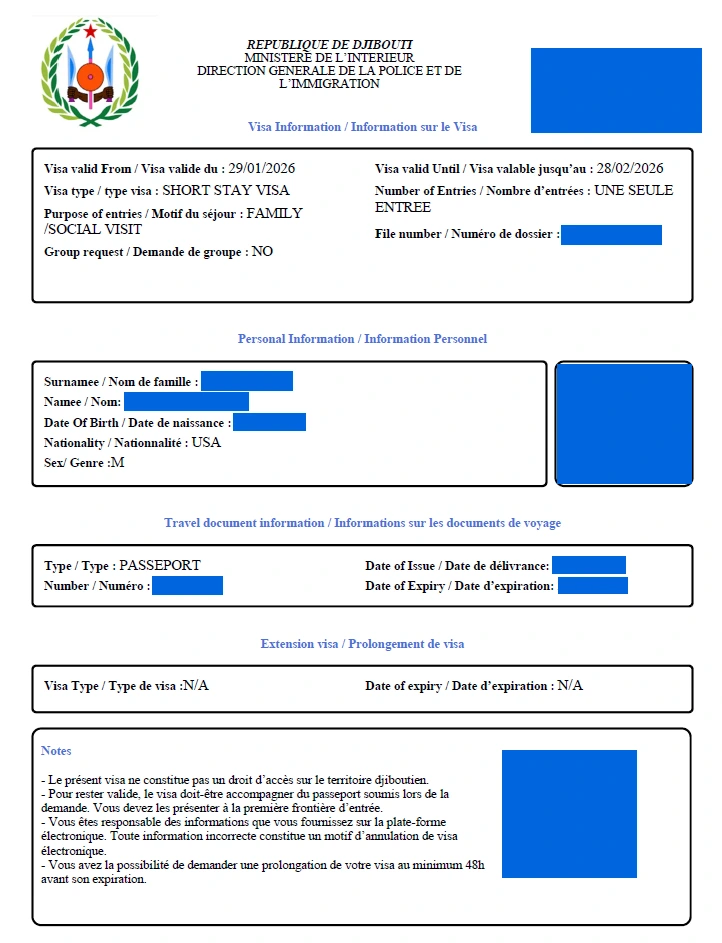
The eVisa is processed through the official government portal at evisa.gouv.dj and is the recommended option for most travelers. Processing takes 4-7 business days, and the approved visa is sent to your email. You must print it and present it at immigration.
The visa on arrival is available at Djibouti-Ambouli International Airport and some land border crossings. Payment is accepted in US dollars (cash only). There are no credit card or mobile payment facilities at the border.
A small number of nationalities – primarily citizens of certain African and Southeast Asian countries – are exempt from visa requirements for short stays. If you hold a passport from a country in the African Union or if bilateral agreements apply, check the latest exemption list on the official eVisa portal or with the nearest Djibouti embassy.
For a detailed breakdown of all visa types, see our guide on Djibouti visa types.
Passport Validity Rules
Your passport must be valid for at least 6 months beyond your planned arrival date in Djibouti. This is strictly enforced – immigration officers will deny entry if your passport expires within 6 months.
Additional passport requirements:
- Your passport must not be reported as lost or stolen
- At least one blank page is required for entry stamps
- Temporary or emergency travel documents may not be accepted
- Damaged passports (water damage, torn pages) can result in denial of entry
Check your passport expiry date well in advance. If your passport expires within 8 months, renew it before applying for a Djibouti visa. The eVisa application requires your passport number, so the details must match exactly.
For full document requirements, see Djibouti visa requirements.
Health and Vaccination Requirements
Yellow fever vaccination is mandatory if you are arriving from a country with risk of yellow fever transmission. You must carry a valid International Certificate of Vaccination or Prophylaxis (ICVP) – commonly called the “yellow card.”
Countries requiring yellow fever certificate on arrival in Djibouti include most Sub-Saharan African nations, parts of South America, and some Central American countries. If you have a layover in a risk country (even without leaving the airport), you may still be asked for the certificate.
Recommended vaccinations (not mandatory but advised by health authorities):
- Hepatitis A and B
- Typhoid
- Meningococcal meningitis
- Rabies (if visiting rural areas)
- Routine vaccinations (MMR, tetanus, polio)
Malaria is present in Djibouti, particularly in rural and coastal areas. Consult your doctor about antimalarial medication before travel. There are no COVID-19 vaccination or testing requirements as of 2024.
For the latest health entry rules, check TravelHealthPro Djibouti or your country’s travel health advisory.
Documents You Need at the Border
When you arrive at Djibouti immigration, you will need to present several documents. Prepare these before landing to avoid delays.
| Document | Required | Notes |
|---|---|---|
| Valid passport | Yes | 6+ months validity, blank page |
| Djibouti visa (eVisa printout or VOA) | Yes | Print eVisa approval email |
| Passport-style photograph | Yes (for VOA) | 1 recent photo, standard size |
| Proof of accommodation | Yes | Hotel booking or host invitation |
| Proof of onward/return travel | Yes | Flight ticket or itinerary |
| Yellow fever certificate | If applicable | Only if arriving from risk country |
| Business invitation letter | For business visa | From Djibouti-based company |
| Travel insurance | Recommended | Not mandatory but strongly advised |
| Cash in US dollars | For VOA | Exact amount preferred |
Tip: Keep all documents in your carry-on luggage. Checked bags are not accessible during immigration processing.
For a step-by-step guide to the application form, see Djibouti visa application form.
Arrival at the Djibouti Border
Djibouti-Ambouli International Airport (JIB) is the primary entry point for international travelers. Here is what to expect step by step:
Step 1: Disembark and proceed to immigration. After leaving the aircraft, follow signs to the immigration hall. There are separate queues for Djibouti nationals and foreign visitors.
Step 2: Present your documents. Hand your passport, printed eVisa (or ask for VOA), and any supporting documents to the immigration officer. The officer will verify your visa, stamp your passport, and may ask about your accommodation and return travel.
Step 3: Obtain visa on arrival (if applicable). If you did not apply for an eVisa, proceed to the VOA counter. Fill out the application form, provide a passport photo, and pay the fee in US dollars cash. Processing at the counter typically takes 15-30 minutes.
Step 4: Collect your luggage. After immigration clearance, proceed to the baggage claim area.
Step 5: Customs inspection. Declare any items subject to duty or restrictions (see customs section below). Green channel is available for travelers with nothing to declare.
Land border crossings are available from Ethiopia (at the Dewele-Galafi crossing), and limited crossings exist with Somalia and Eritrea. Land border facilities are more basic, and VOA may not be available at all crossings. The eVisa is only valid for air entry at Ambouli Airport – if entering by land, you must obtain a visa through a Djibouti embassy or at the border.
eVisa vs Visa on Arrival: Which Should You Choose?
Both options grant the same type of entry authorization, but they differ in convenience, cost, and entry points.
| Feature | eVisa | Visa on Arrival |
|---|---|---|
| Application | Online at evisa.gouv.dj | At immigration counter |
| Processing time | 4-7 business days | 15-30 minutes at the airport |
| Cost | $23 USD (standard tourist) | ~$23 USD (varies slightly) |
| Payment | Online (card) | Cash in US dollars only |
| Valid for air entry | Yes, Ambouli Airport only | Yes, Ambouli Airport |
| Valid for land entry | No | Some land borders |
| Document upload | Online (passport scan, photo) | Physical documents at counter |
| Risk of denial at border | Low (pre-approved) | Higher (documents checked on arrival) |
The eVisa is recommended because it removes uncertainty. You know your visa is approved before you board your flight. The VOA is a fallback option if you could not apply in advance – but arrive prepared with all documents and exact USD cash.
For detailed VOA information, see Djibouti visa on arrival.
Customs Rules and Declarations
Djibouti customs regulations require you to declare certain items upon arrival. Failure to declare can result in fines, confiscation, or detention.
Duty-free allowances:
- 200 cigarettes or 50 cigars or 250g of tobacco
- 1 liter of spirits and 1 liter of wine
- Reasonable quantity of perfume for personal use
- Gifts up to a reasonable value
Prohibited items:
- Narcotics and illegal drugs
- Pornographic material
- Firearms and ammunition (without permit)
- Counterfeit goods
- Items offensive to Islamic values
Restricted items requiring declaration:
- Large amounts of cash (over $10,000 USD or equivalent)
- Medications (carry a doctor’s prescription)
- Electronic equipment for commercial use
- Plants, seeds, and agricultural products
Djibouti is a Muslim-majority country. Respect local customs and laws regarding alcohol consumption, dress code, and public behavior. Alcohol is available in hotels and licensed establishments but not in public spaces.
Special Cases: Transit, Minors, and Dual Nationals
Transit passengers who remain in the airport’s international transit area do not need a visa. However, if your layover is long and you wish to leave the airport, you must obtain a transit visa (valid for up to 14 days) or a standard tourist eVisa. The transit eVisa is more cost-effective for short stays.
Children and minors need their own individual visa – there are no age exemptions. For minors traveling with one parent, you may need a notarized consent letter from the non-traveling parent. Carry the child’s birth certificate as supporting documentation.
Dual nationals should enter and exit Djibouti on the same passport. If you hold Djibouti nationality alongside another citizenship, Djibouti authorities may treat you as a Djibouti citizen, which could affect consular assistance from your other country of citizenship.
For the full application process, see Djibouti visa application.
Frequently Asked Questions
Do I need a visa to enter Djibouti?
Yes. Almost all foreign nationals need a visa to enter Djibouti. You can apply for an eVisa online at evisa.gouv.dj before travel, or obtain a visa on arrival at Djibouti-Ambouli International Airport. Citizens of a small number of African and Asian countries may be exempt – check the official portal for the latest exemption list.
How long must my passport be valid to enter Djibouti?
Your passport must be valid for at least 6 months beyond your date of arrival in Djibouti. If your passport expires sooner, renew it before applying for a visa or traveling.
Can I enter Djibouti by land with an eVisa?
No. The eVisa is only valid for air entry through Djibouti-Ambouli International Airport. If you plan to enter by land (for example, from Ethiopia at the Dewele-Galafi crossing), you need a visa from a Djibouti embassy or a visa on arrival at the land border, where available.
Do I need a yellow fever vaccination for Djibouti?
Yes, if you are arriving from a country with risk of yellow fever transmission. You must carry a valid International Certificate of Vaccination (yellow card). This applies even if you only had a layover in a risk country. Travelers arriving from non-risk countries do not need the certificate.
How much does the Djibouti visa cost?
The standard tourist eVisa costs approximately $23 USD. The visa on arrival is similarly priced, payable in US dollars cash at the airport. Business and transit visas may have different fees.
What happens if I arrive without a visa?
If you arrive at Ambouli Airport without a pre-approved eVisa, you can apply for a visa on arrival at the immigration counter. However, if you are ineligible for VOA or lack the required documents (passport photo, proof of accommodation, USD cash), you may be denied entry and placed on a return flight.
Do children need their own Djibouti visa?
Yes. Every traveler, including infants and children, must have their own individual visa. For minors, you should carry the child’s birth certificate and, if only one parent is traveling, a notarized consent letter from the other parent.
Can I transit through Djibouti airport without a visa?
Yes, if you remain in the international transit area of the airport and do not pass through immigration. If you need to leave the transit area or have a long layover, you must obtain a transit visa or tourist visa.
What currency should I bring for the visa on arrival?
US dollars (cash only). Credit cards, debit cards, and other currencies are not accepted at the VOA counter. Bring the exact amount if possible, as change may not be available.
Is travel insurance required for Djibouti entry?
Travel insurance is not a mandatory entry requirement, but it is strongly recommended. Medical facilities in Djibouti are limited, and evacuation to a neighboring country may be necessary in emergencies. Ensure your policy covers the Horn of Africa region.